                                 MK: Recycling
  Where tours are free
It wouldn't have been my first choice for a good night out - a trip around Milton Keynes recycling plant. But with the lure of a post-tour curry, it started to sound more fun. Turned out it was quite fun too. We learnt exactly how much it costs per tonne for the black sacks of waste to go into landfill. That's £84, whereas the pink sacks cost nothing.
We learnt that the landfill sites are filling up, and eventually we will run out of space. We watched how the recycled material is sorted and collated, and that all sorts of things - even fleeces - are made from the
proceeds.
We also learnt about what you can and should recycle. More of that later.
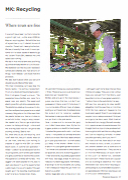
The most interesting part was how the factory works - the sorting process itself. It's all very clever and fascinating to watch. First, it all goes through a shaker. This separates heavy bottles and cans from paper, card and plastic. The paper and plastic goes through into a separate area. The plastic is sucked up by a vacuum tube, and the cardboard and paper is separated manually. Magnets so  out the cans from the plastic bottles and then aluminium is sorted still further  using an eddy-current that repels them. You can get a quick tour
around the factory, although I understand that evening tours now will not get to see anything working. Shame that.
So, what should you be recycling, and how? Well first, the pink sacks. Most of us use them, and they cost nothing to dispose of (against that £84 per tonne black sack). A commercial operation - Viridor - collect the sorted waste from the recycling centre, sell it on the open market and give a commission back to the council. The operation is entirely self-fu nded. The biggest pink sack surprise for me, was to learn we shouldn't put the supermarket plastic bags into our pink sacks. They get caught up in the recycling machines and slow the whole process down. Oops.
Oh, and I didn't know you could put clothes in there. Those single socks and worn out
jeans now get recycled too.
Bottles and jars go in the blue boxes, I guess you knew that too, but don't put glassware in there, even if it's broken. It is a completely different type of glass, melting at a different rate. It contaminates the output and is rendered useless. Remember to take your lids off the bottles and put them in the pink sacks. Now-anewoneformewasthegrey box. I didn't know about them. By far the biggest problem on landfill is food waste. It creates the gases and smells - methane mainly - that pollute our atmosphere and affect our climate. Well food waste should go in your grey food box - a small caddy you keep in the kitchen. When it's full, empty it into your green garden waste bin. Then the whole caboodle is collected and composted. Job done. Everything goes in - meat and bones, veg waste, paper soiled with food, tea bags, bread. It's seriously reduced my black bag waste. Admittedly, emptying it is not my favourite job. Lining it with newspaper helps though. And I do
feel virtuous after!
Battery bags were also a new one on me
- although I can't remember the last time I threw one away. They are small yellow bags you can get from the library. Just leave them on top of your green waste bin. That's on top on the outside by the way. MK say they are going to stop landfill altogether. And they say they will do it by 2016. So then, what will happen to the black sack waste? Even if you religiously recycle, there is always some stuff that just must go in the black sack. Well, it will all be done with technology. Burned basically, but in special anaerobic waste burners. It is thought that the bi-products produced will be enough to both heat the recycling plant and fuel the recycling vehicles. A rather beautiful symmetry, don't you think?
The tours are free, take about an hour and include a video, a talk, a question and answer session and a walk around the recycling centre itself. They are held on the first Wednesday of each month at the plant at Wolverton, between 6pm and 7pm. These tours are popular and so booking is essential. For more information visit www.milton-keynes.gov. uk/recycling-tours, email waste education: on wasteeducation@milton-keynes.gov.uk or simply call: 01908 25231 2
Phonebox Magazine 87