


Page 6 - Demo
P. 6
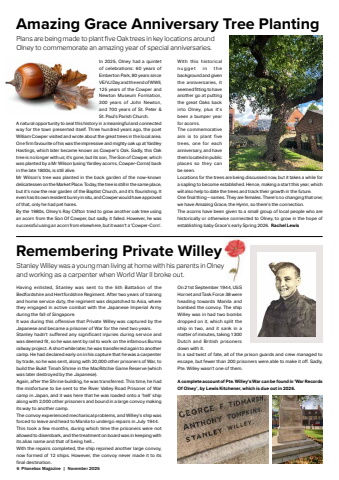
6 Phonebox Magazine | November 2025Amazing Grace Anniversary Tree PlantingPlans are being made to plant fi ve Oak trees in key locations around Olney to commemorate an amazing year of special anniversaries.In 2025, Olney had a quintet of celebrations: 60 years of Emberton Park, 80 years since VE/VJ Day and the end of WWII, 125 years of the Cowper and Newton Museum Formation, 300 years of John Newton, and 700 years of St. Peter & St. Paul%u2019s Parish Church.A natural opportunity to seal this history in a meaningful and connected way for the town presented itself. Three hundred years ago, the poet William Cowper visited and wrote about the great trees in the local area. One fi rm favourite of his was the impressive and mighty oak up at Yardley Hastings, which later became known as Cowper%u2019s Oak. Sadly, this Oak tree is no longer with us; it%u2019s gone, but its son, The Son of Cowper, which was planted by a Mr Wilson (using Yardley acorns, Cowper-Corns) back in the late 1800s, is still alive. Mr Wilson%u2019s tree was planted in the back garden of the now-known delicatessen on the Market Place. Today, the tree is still in the same place, but it%u2019s now the rear garden of the Baptist Church, and it%u2019s fl ourishing. It even has its own resident bunny in situ, and Cowper would have approved of that, only he had pet hares. By the 1980s, Olney%u2019s Ray Clifton tried to grow another oak tree using an acorn from the Son Of Cowper, but sadly, it failed. However, he was successful using an acorn from elsewhere, but it wasn%u2019t a %u2018Cowper-Corn%u2019. With this historical n u g g e t i n t h e background and given the anniversaries, it seemed fi tting to have another go at putting the great Oaks back into Olney, plus it%u2019s been a bumper year for acorns. The commemorative aim is to plant five trees, one for each anniversary, and have them located in public places so they can be seen. Locations for the trees are being discussed now, but it takes a while for a sapling to become established. Hence, making a start this year, which will also help to date the trees and track their growth in the future. One fi nal thing %u2013 names. They are females. There%u2019s no changing that one; we have Amazing Grace, the Hymn, so there%u2019s the connection. The acorns have been given to a small group of local people who are historically or otherwise connected to Olney, to grow in the hope of establishing baby Grace%u2019s early Spring 2026. Rachel LewisHaving enlisted, Stanley was sent to the 5th Battalion of the Bedfordshire and Hertfordshire Regiment. After two years of training and home service duty, the regiment was dispatched to Asia, where they engaged in active combat with the Japanese Imperial Army during the fall of Singapore. It was during this off ensive that Private Willey was captured by the Japanese and became a prisoner of War for the next two years. Stanley hadn%u2019t suff ered any signifi cant injuries during service and was deemed fi t, so he was sent by rail to work on the infamous Burma railway project. A short while later, he was transferred again to another camp. He had declared early on in his capture that he was a carpenter by trade, so he was sent, along with 20,000 other prisoners of War, to build the Bukit Timah Shrine in the MacRitchie Game Reserve (which was later destroyed by the Japanese). Again, after the Shrine building, he was transferred. This time, he had the misfortune to be sent to the River Valley Road Prisoner of War camp in Japan, and it was here that he was loaded onto a %u2018hell%u2019 ship along with 2,000 other prisoners and bound in a large convoy making its way to another camp. The convoy experienced mechanical problems, and Willey%u2019s ship was forced to leave and head to Manila to undergo repairs in July 1944. This took a few months, during which time the prisoners were not allowed to disembark, and the treatment on board was in keeping with its alias name and that of being hell...With the repairs completed, the ship rejoined another large convoy, now formed of 12 ships. However, the convoy never made it to its fi nal destination. On 21st September 1944, USS Hornet and Task Force 38 were heading towards Manila and bombed the convoy. The ship Willey was in had two bombs dropped on it, which split the ship in two, and it sank in a matter of minutes, taking 1300 Dutch and British prisoners down with it. In a sad twist of fate, all of the prison guards and crew managed to escape, but fewer than 200 prisoners were able to make it off . Sadly, Pte. Willey wasn%u2019t one of them. A complete account of Pte. Willey%u2019s War can be found in %u2018War Records Of Olney%u2019, by Lewis Kitchener, which is due out in 2026.Remembering Private Willey Stanley Willey was a young man living at home with his parents in Olney and working as a carpenter when World War II broke out.


