


Page 14 - Demo
P. 14
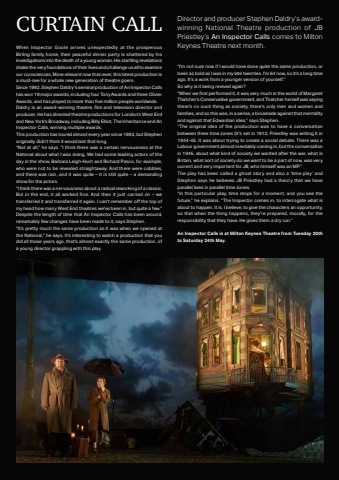
14 Phonebox Magazine | May 2025Director and producer Stephen Daldry%u2019s awardwinning National Theatre production of JB Priestley%u2019s An Inspector Calls comes to Milton Keynes Theatre next month.CURTAIN CALLWhen Inspector Goole arrives unexpectedly at the prosperous Birling family home, their peaceful dinner party is shattered by his investigations into the death of a young woman. His startling revelations shake the very foundations of their lives and challenge us all to examine our consciences. More relevant now than ever, this latest production is a must-see for a whole new generation of theatre goers. Since 1992, Stephen Daldry%u2019s seminal production of An Inspector Calls has won 19 major awards, including four Tony Awards and three Olivier Awards, and has played to more than fi ve million people worldwide. Daldry is an award-winning theatre, fi lm and television director and producer. He has directed theatre productions for London's West End and New York's Broadway, including Billy Elliot, The Inheritance and An Inspector Calls, winning multiple awards. This production has toured almost every year since 1992, but Stephen originally didn%u2019t think it would last that long.%u201cNot at all,%u201d he says. %u201cI think there was a certain nervousness at the National about what I was doing. We had some leading actors of the day in the show, Barbara Leigh-Hunt and Richard Pasco, for example, who were not to be revealed straightaway. And there were cobbles, and there was rain, and it was quite %u2013 it is still quite %u2013 a demanding show for the actors.%u201cI think there was a nervousness about a radical reworking of a classic. But in the end, it all worked fi ne. And then it just carried on %u2013 we transferred it and transferred it again. I can't remember off the top of my head how many West End theatres we've been in, but quite a few.%u201dDespite the length of time that An Inspector Calls has been around, remarkably few changes have been made to it, says Stephen.%u201cIt's pretty much the same production as it was when we opened at the National,%u201d he says. It's interesting to watch a production that you did all those years ago, that's almost exactly the same production, of a young director grappling with this play. %u201cI'm not sure now if I would have done quite the same production, or been as bold as I was in my late twenties. I'm 64 now, so it's a long time ago. It%u2019s a work from a younger version of yourself.%u201dSo why is it being revived again?%u201cWhen we fi rst performed it, it was very much in the world of Margaret Thatcher's Conservative government, and Thatcher herself was saying there's no such thing as society, there's only men and women and families, and so this was, in a sense, a broadside against that mentality and against that Edwardian idea,%u201d says Stephen.%u201cThe original idea of the production was to have a conversation between three time zones (it%u2019s set in 1912, Priestley was writing it in 1944-45. It was about trying to create a social debate. There was a Labour government almost inevitably coming in, but the conversation in 1945, about what kind of society we wanted after the war, what is Britain, what sort of society do we want to be a part of now, was very current and very important for JB, who himself was an MP.%u201dThe play has been called a ghost story and also a %u2018time play%u2019 and Stephen says he believes JB Priestley had a theory that we have parallel lives in parallel time zones.%u201cIn this particular play, time stops for a moment, and you see the future,%u201d he explains. %u201cThe Inspector comes in, to interrogate what is about to happen. It is, I believe, to give the characters an opportunity, so that when the thing happens, they're prepared, morally, for the responsibility that they have. He gives them a dry run.%u201dAn Inspector Calls is at Milton Keynes Theatre from Tuesday 20th to Saturday 24th May.


