


Page 12 - Phonebox Magazine October 2014
P. 12
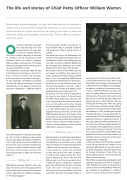
The life and stories of Chief Petty Officer William Warren
Quaint cottages littered winding lanes, the church bells chimed and early each morning the villagers went out to work in 1915 England. But Britain was in a state of transition; war had been declared last August, men and boys were leaving for the trenches in droves and women were heading into the workplace for the first time. The Great War was making its mark on the public.
One Stoke Goldington teenager who was watching the world change before his eyes was 15-year-old William Warren.
The son of a farmer, like many of his peers he wanted to join up. Knowing he would otherwise follow in his father’s footsteps, William wanted something more. The military offered a good wage and the chance to travel, as well as defend his country.
One September morning he made his way to Northampton and picked up the form to enlist, not that his mother was too keen, and she pointed out one flaw in his plan – he was underage. But William persuaded her that the military would give him more opportunities, so she signed it declaring he was born on September 1, 1899 (not 1900). It
was commonplace for underage boys to sign up, with records not being as organised as they are now. Many were sent to the Western Front to fight in the horrendous conditions of the trenches, but in joining the Royal Navy, it was just a matter of weeks before he was sent down to Portsmouth, the hub of the world’s largest navy, to begin his training as a gunner.
Setting sail
HMS Minerva became William’s first home away from home, as the teenager joined the crew on their way to Crimea off north western Turkey, supporting the Gallipoli Campaign. 12 Phonebox Magazine
From the sparse English countryside, he found himself living in cramped conditions with hundreds of others, facing a future of combat.
She made her way to the Dardanelles, but Turkish troops trapped the Allied forces on the beaches. It wasn’t until the following year that, after 10 months of fighting, William and his comrades were withdrawn, but 43,000 British men lost their lives in the process. But his part in the First World War had only just began, and William was deployed to China, and then to the Indian Ocean and Red Sea, in 1917. He stayed with HMS Minerva running patrols off East Africa for three years, protecting it from the German threat, until the war finally ended in July 1918. It wasn’t for another two months that William would celebrate turning the tender age of 18. Facing the rest of his career in peacetime, he made his way back to Portsmouth and the HMS Victory Royal Navy Barracks (not to be confused with the ship which was at a buoy in the harbour at the time). Serving as accommodation for men awaiting a draft to a ship, William spent the next 20 years regularly returning to the site, as well as the HMS Excellent barracks, both based in the south coast city. But his time spent defending Britain’s interests was still ongoing, and from 1918 to 1920 he served on HMS Carlisle in China, as well as heading to London and the HMS Nelson barracks in Norwich.
The peace years
Even though the war had finally ended, Britain was still finding its feet again. The country was adjusting to a post-war world; it owed millions to America, the staple industries were in decline and the economy was suffering. It was during the 1920s that hundreds of men were sent to the heart of Wales, to help provide support during the miner strikes. Wages were lower than ever and William was one of the troops sent across to keep the peace. Camping in a Newport park, they attracted the attention of curious locals, with some of the girls wanting to see what all the fuss was about. It was one such Welsh girl, Elsie, that caught William’s
eye, and went on to become his future wife. Love quickly blossomed, and it wasn’t long before they were married and heading back to Portsmouth where William found lodgings for them on one level of a three-story house. It was in 1925 that William was given the rank of Leading Seaman and his growing family became his priority. After sadly losing their first born while he was still a baby, Ron Warren was born in 1927, with his sister Iris arriving the following year. Now only going on 9-month tours on the naval ships, William made sure to send money back to them while he was away. In 1930, he was given the title of Leading Gunner, and a few years later he made his way to China, defending Shanghai against the threat of a Japanese invasion. It was years later that William admitted to his son that once a Chinese soldier mistook him for a member of the Japanese force and ran at him with his bayonet. Fearing for his life over a case of mistaken identity, William was pushed out of the way at the last minute by a comrade and no-one was hurt, but he never forgot the day it happened.
In 1936, just three years before the outbreak of the Second World War, William found himself on HMS Danae on the other side of the world in Australia. It was there that he took his training to become a Petty Officer, the second highest rank for a non-commissioned officer in the Royal Navy.
While Hitler was gradually gaining power and making his presence in known in Europe in 1939, William was coming to the end of his career and life in the Royal Navy. When war was declared on September 1, William’s future of a quiet civilian life was forgotten.


