


Page 13 - Phonebox Magazine October 2014
P. 13
Stoke Goldington native served in the Royal Navy from 1915-1945 Mischa Allen
military history at the Battle of Cape Matapan. It was the last fleet action fought by the Royal Navy for the rest of the century.
On the southwest coast of Greece, the father- of-two was part of a force of ships (acting on knowledge obtained at Bletchley Park) that sank or severely damaged enemy ships. HMS Formidable sent planes into the sky, providing cover for the fleet below.
The home straight
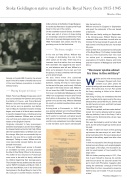
In his role as Petty Officer, William was in charge of distributing the rum to the other sailors on the ship. There may be a common view that sailors love rum during their downtime. But apparently this wasn’t so, and whatever was left was William’s to drink as he pleased. As you can see from the picture, he was sometimes left with quite a bit to drink himself.
He was there when she sustained considerable damage from German dive- bombers, leaving the ship to need repairs for the rest of the year, and in early 1942 she took part in the Indian Ocean raid. William’s life on board the HMS Formidable was far from over, and defended Madagascar in mid 1942 from a Japanese invasion and French North Africa in November. As a Petty Officer gunner on board the ship, William defended his country in combat countless times across the world.
Arriving back in Portsmouth, in 1943, he was quickly whisked up to the Royal Military Hospital in Aberdeen. The records aren’t clear, but it seems he received a shrapnel wound and spent 6 months there to recuperate. His son Ron only remembers his mother leaving to visit his father, but it wasn’t until decades
later he learnt why.
William returned to England in September and spent the remainder of the war based at barracks .
With the war finally ending on September 2 the following year, William Warren was released a little more than a month later on October 8. He’d just turned 45 years old, and had served in the Royal Navy for more than 30 years.
Given a letter from a Lieutenant Commander of the Royal Navy, C G Cowley, he described him as a ‘fine trustworthy man’ who took ‘an active part in minesweeping, the evacuations of Dunkirk, Greece and Crete and the invasions of Madagascar and North Africa.’
“He never spoke about his time in the military”
Already on board HMS Coventry, he arrived back in the UK a matter of weeks before one of the most famous evacuations in modern military history.
Playing his part in history
British, French and Belgian troops were cut off and surrounded by the German army during the Battle of France, and Prime Minister Winston Churchill made the decision to get them out as soon as possible. Just before 7pm on May 26, Operation Dynamo formally began, and boats of all kinds were recruited to save the trapped troops, including an array of paddle steamers. William was on board one such boat as it sailed across the choppy waters of the English Channel.
Originally intended to ferry passengers between Southampton and the Isle of Wight, the Gracie Fields had lost its first Petty Officer after he had been killed, so William took over the charge. After just one successful trip on May 29, she was hit by a bomb and badly damaged. Taking on water, William and his crew were luckily rescued before she sank beneath the waves.
In the end, William went across to Dunkirk an incredible six times, and was awarded the title of Chief Petty Officer for his bravery. The father-of-two returned to Portsmouth once more to be with his family, with both his children beginning their teenage years. That October he was drafted onto the aircraft carrier HMS Formidable until March 1943. It was here that William, now in his forties and having been in the Royal Navy for most of his life, took part in another historic moment in
W
illiam and his wife moved back to Newport Pagnell with their
children soon after, where he ended up taking a job as a driver with the post office. The same year, his son Ron joined the Army, wanting to follow in his father’s
footsteps.
Now living in Olney, he remembers the time well: “I wanted dad to sign me up for the navy, because they can do that for you. But he said he didn’t want me to join, and that I had seen enough through him.
“After the war ended, and two weeks before I turned 18, I had my physical and two weeks after my birthday I was in the Army. I left in 1948 to join the Territorial Army, where I was for 24 years.”
Ron was fascinated by what his father had done, but he rarely brought up stories about his past.
He adds: “I didn’t see much of him growing up because he was away a lot, and I didn’t know much about him. He never spoke about his time in the military, apart from after a few drinks.
“I think he enjoyed his time though because he kept so many things, such as photographs and images of the ships. He recorded it all, and he would speak of how beautiful the ships were.’
With his father passing away in 1971, Ron took it upon himself to draw up his records and find out about his colourful career. He got in touch with Phonebox magazine after seeing the centenary coverage of the First World War. For Ron, he wanted to share his father’s story, as he adds: “I’m just so proud of him.”
Phonebox Magazine 13


