


Page 6 - Demo
P. 6
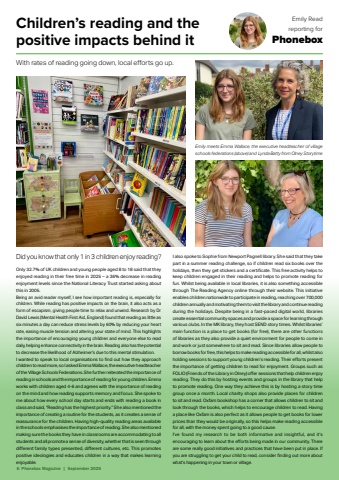
6 Phonebox Magazine | September 2025Children%u2019s reading and the positive impacts behind itWith rates of reading going down, local eff orts go up. Did you know that only 1 in 3 children enjoy reading?Only 32.7% of UK children and young people aged 8 to 18 said that they enjoyed reading in their free time in 2025 %u2013 a 36% decrease in reading enjoyment levels since the National Literacy Trust started asking about this in 2005. Being an avid reader myself, I see how important reading is, especially for children. While reading has positive impacts on the brain, it also acts as a form of escapism, giving people time to relax and unwind. Research by Dr David Lewis (Mental Health First Aid, England) found that reading as little as six minutes a day can reduce stress levels by 60% by reducing your heart rate, easing muscle tension and altering your state of mind. This highlights the importance of encouraging young children and everyone else to read daily, helping enhance connectivity in the brain. Reading also has the potential to decrease the likelihood of Alzheimer%u2019s due to this mental stimulation.I wanted to speak to local organisations to fi nd out how they approach children to read more, so I asked Emma Wallace, the executive headteacher of the Village Schools Federations. She further reiterated the importance of reading in schools and the importance of reading for young children. Emma works with children aged 4-6 and agrees with the importance of reading on the mind and how reading supports memory and focus. She spoke to me about how every school day starts and ends with reading a book in class and said, %u201cReading has the highest priority.%u201d She also mentioned the importance of creating a routine for the students, as it creates a sense of reassurance for the children. Having high-quality reading areas available in the schools emphasises the importance of reading. She also mentioned making sure the books they have in classrooms are accommodating to all students and all promote a sense of diversity, whether that is seen through diff erent family types presented, diff erent cultures, etc. This promotes positive ideologies and educates children in a way that makes learning enjoyable.I also spoke to Sophie from Newport Pagnell library. She said that they take part in a summer reading challenge, so if children read six books over the holidays, then they get stickers and a certifi cate. This free activity helps to keep children engaged in their reading and helps to promote reading for fun. Whilst being available in local libraries, it is also something accessible through The Reading Agency online through their website. This initiative enables children nationwide to participate in reading, reaching over 700,000 children annually and motivating them to visit the library and continue reading during the holidays. Despite being in a fast-paced digital world, libraries create essential community spaces and provide a space for learning through various clubs. In the MK library, they host SEND story times. Whilst libraries%u2019 main function is a place to get books (for free), there are other functions of libraries as they also provide a quiet environment for people to come in and work or just somewhere to sit and read. Since libraries allow people to borrow books for free, this helps to make reading accessible for all, whilst also holding sessions to support young children%u2019s reading. Their eff orts present the importance of getting children to read for enjoyment. Groups such as FOLIO (Friends of the Library in Olney) off er sessions that help children enjoy reading. They do this by hosting events and groups in the library that help to promote reading. One way they achieve this is by hosting a story time group once a month. Local charity shops also provide places for children to sit and read. Oxfam bookshop has a corner that allows children to sit and look through the books, which helps to encourage children to read. Having a place like Oxfam is also perfect as it allows people to get books for lower prices than they would be originally, so this helps make reading accessible for all, with the money spent going to a good cause. I%u2019ve found my research to be both informative and insightful, and it%u2019s encouraging to learn about the eff orts being made in our community. There are some really good initiatives and practices that have been put in place. If you are struggling to get your child to read, consider fi nding out more about what%u2019s happening in your town or village.PhoneboxEmily Readreporting forEmily meets Emma Wallace, the executive headteacher of village schools federations (above) and Lynda Batty from Olney Storytime


