


Page 38 - Demo
P. 38
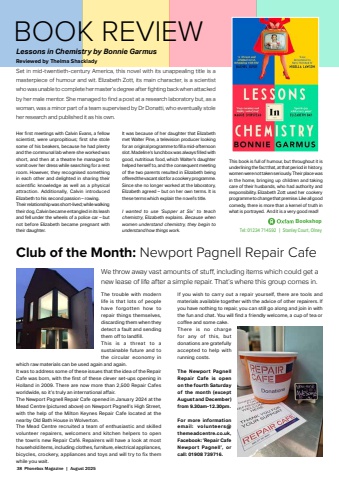
38 Phonebox Magazine | August 2025Club of the Month: Newport Pagnell Repair CafeWe throw away vast amounts of stuff , including items which could get a new lease of life after a simple repair. That%u2019s where this group comes in.The trouble with modern life is that lots of people have forgotten how to repair things themselves, discarding them when they detect a fault and sending them off to landfi ll. This is a threat to a sustainable future and to the circular economy in which raw materials can be used again and again.It was to address some of these issues that the idea of the Repair Cafe was born, with the fi rst of these clever set-ups opening in Holland in 2009. There are now more than 2,500 Repair Cafes worldwide, so it%u2019s truly an international aff air. The Newport Pagnell Repair Cafe opened in January 2024 at the Mead Centre (pictured above) on Newport Pagnell%u2019s High Street, with the help of the Milton Keynes Repair Cafe located at the nearby Old Bath House in Wolverton.The Mead Centre recruited a team of enthusiastic and skilled volunteer repairers, welcomers and kitchen helpers to open the town%u2019s new Repair Caf%u00e9. Repairers will have a look at most household items, including clothes, furniture, electrical appliances, bicycles, crockery, appliances and toys and will try to fi x them while you wait. If you wish to carry out a repair yourself, there are tools and materials available together with the advice of other repairers. If you have nothing to repair, you can still go along and join in with the fun and chat. You will fi nd a friendly welcome, a cup of tea or coff ee and some cake. There is no charge for any of this, but donations are gratefully accepted to help with running costs. The Newport Pagnell Repair Cafe is open on the fourth Saturday of the month (except August and December) from 9.30am-12.30pm. For more information email: volunteers@themeadcentre.co.uk, Facebook: %u2018Repair Cafe Newport Pagnell%u2019, or call: 01908 739716.Her fi rst meetings with Calvin Evans, a fellow scientist, were unpropitious; first she stole some of his beakers, because he had plenty and the communal lab where she worked was short, and then at a theatre he managed to vomit over her dress while searching for a rest room. However, they recognised something in each other and delighted in sharing their scientific knowledge as well as a physical attraction. Additionally, Calvin introduced Elizabeth to his second passion %u2013 rowing.Their relationship was short-lived; while walking their dog, Calvin became entangled in its leash and fell under the wheels of a police car %u2013 but not before Elizabeth became pregnant with their daughter.Reviewed by Thelma ShackladyLessons in Chemistry by Bonnie GarmusSet in mid-twentieth-century America, this novel with its unappealing title is a masterpiece of humour and wit. Elizabeth Zott, its main character, is a scientist who was unable to complete her master%u2019s degree after fi ghting back when attacked by her male mentor. She managed to fi nd a post at a research laboratory but, as a woman, was a minor part of a team supervised by Dr Donatti, who eventually stole her research and published it as his own.It was because of her daughter that Elizabeth met Walter Pine, a television producer looking for an original programme to fi ll a mid-afternoon slot. Madeline%u2019s lunchbox was always fi lled with good, nutritious food, which Walter%u2019s daughter helped herself to, and the consequent meeting of the two parents resulted in Elizabeth being off ered the vacant slot for a cookery programme. Since she no longer worked at the laboratory, Elizabeth agreed %u2013 but on her own terms. It is these terms which explain the novel%u2019s title.I wanted to use %u2018Supper at Six%u2019 to teach chemistry, Elizabeth explains. Because when women understand chemistry, they begin to understand how things work.BookshopTel: 01234 714592 | Stanley Court, OlneyBOOK REVIEWThis book is full of humour, but throughout it is underlining the fact that, at that period in history, women were not taken seriously. Their place was in the home, bringing up children and taking care of their husbands, who had authority and responsibility. Elizabeth Zott used her cookery programme to change that premise. Like all good comedy, there is more than a kernel of truth in what is portrayed. And it is a very good read!


