


Page 50 - Demo
P. 50
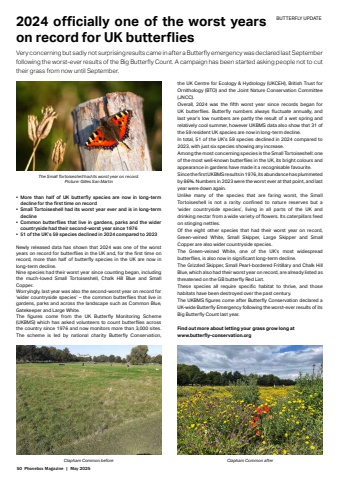
50 Phonebox Magazine | May 2025%u2022%u2002 More than half of UK butterfl y species are now in long-term decline for the fi rst time on record%u2022%u2002 Small Tortoiseshell had its worst year ever and is in long-term decline%u2022%u2002 Common butterfl ies that live in gardens, parks and the wider countryside had their second-worst year since 1976%u2022%u200251 of the UK%u2019s 59 species declined in 2024 compared to 2023Newly released data has shown that 2024 was one of the worst years on record for butterfl ies in the UK and, for the fi rst time on record, more than half of butterfl y species in the UK are now in long-term decline.Nine species had their worst year since counting began, including the much-loved Small Tortoiseshell, Chalk Hill Blue and Small Copper.Worryingly, last year was also the second-worst year on record for %u2018wider countryside species%u2019 %u2013 the common butterfl ies that live in gardens, parks and across the landscape such as Common Blue, Gatekeeper and Large White.The fi gures come from the UK Butterfl y Monitoring Scheme (UKBMS) which has asked volunteers to count butterfl ies across the country since 1976 and now monitors more than 3,000 sites. The scheme is led by national charity Butterfl y Conservation, the UK Centre for Ecology & Hydrology (UKCEH), British Trust for Ornithology (BTO) and the Joint Nature Conservation Committee (JNCC).Overall, 2024 was the fi fth worst year since records began for UK butterfl ies. Butterfl y numbers always fl uctuate annually, and last year%u2019s low numbers are partly the result of a wet spring and relatively cool summer, however UKBMS data also show that 31 of the 59 resident UK species are now in long-term decline.In total, 51 of the UK%u2019s 59 species declined in 2024 compared to 2023, with just six species showing any increase.Among the most concerning species is the Small Tortoiseshell: one of the most well-known butterfl ies in the UK, its bright colours and appearance in gardens have made it a recognisable favourite.Since the fi rst UKBMS results in 1976, its abundance has plummeted by 86%. Numbers in 2023 were the worst ever at that point, and last year were down again.Unlike many of the species that are faring worst, the Small Tortoiseshell is not a rarity confi ned to nature reserves but a %u2018wider countryside species%u2019, living in all parts of the UK and drinking nectar from a wide variety of fl owers. Its caterpillars feed on stinging nettles.Of the eight other species that had their worst year on record, Green-veined White, Small Skipper, Large Skipper and Small Copper are also wider countryside species.The Green-veined White, one of the UK%u2019s most widespread butterfl ies, is also now in signifi cant long-term decline.The Grizzled Skipper, Small Pearl-bordered Fritillary and Chalk Hill Blue, which also had their worst year on record, are already listed as threatened on the GB butterfl y Red List.These species all require specifi c habitat to thrive, and those habitats have been destroyed over the past century.The UKBMS fi gures come after Butterfl y Conservation declared a UK-wide Butterfl y Emergency following the worst-ever results of its Big Butterfl y Count last year.Find out more about letting your grass grow long at www.butterfl y-conservation.org2024 offi cially one of the worst years on record for UK butterfl iesBUTTERFLY UPDATEThe Small Tortoiseshell had its worst year on record. Picture: Gilles San MartinClapham Common before Clapham Common afterVery concerning but sadly not surprising results came in after a Butterfl y emergency was declared last September following the worst-ever results of the Big Butterfl y Count. A campaign has been started asking people not to cut their grass from now until September.


