


Page 58 - Phonebox Magazine March 2016
P. 58
Easter Rising
Easter was late in 1916 with Good Friday falling on the 21st April. Ireland had been relatively quiet since the beginning of the war and
differences boiling before August 1914 put on the back burner.
Ireland, since the 1800 Act of Union, had been joined politically to Westminster and throughout the century Irish Nationalists had worked to regain their independence. Gladstone’s Liberal government had attempted home rule in 1886 but had been defeated in the Commons and again in 1893 by the House of Lords.
The December 1910 general election left no senior party with a majority but with the Irish Nationalists the Liberals could form a government with the price being Irish Home Rule.
Sir Edward Carson, leader of the Irish Unionists, opposed the making of a Dublin government with a Roman Catholic majority imposed on the Protestants of Ulster and in 1913 formed the Ulster Volunteer Force (UVF) a military organisation which was quickly armed. The Irish Republican Brotherhood, a nationalist organisation, soon organised itself into a military unit and an Irish civil war seemed imminent. Many senior of cers in the British Army were Irish Protestants and against Home Rule and it was only the outbreak of war with Germany that prevented a civil war in 1914. The Home Rule Act was suspended at the outbreak for twelve months and further suspended at the end of the  rst period. Controversially the act contained articles concerning enforced conscription that caused consternation within the Irish community. The linking of this Act with conscription forced the Irish nationalists to walk out of Westminster in protest and begin opposition.
Many Irishmen, both Catholic and Protestant volunteered for Kitchener’s New Army and the 36th Division was made up completely from the military wing of the UVF. It was already trained and was uniformed within six weeks of the outbreak of war.
The more extreme members of the Nationalists, the Irish Volunteers, began work within a month of hostilities with Germany and what some might call treason, worked to organise rebellion and acquire assistance from Germany. The responsibility for the planning of the Rising was given to Sean McDermott and Tom Clark. Joseph Plunkett, Head of Military Operations, travelled to Germany and met Roger Casement, who had travelled from the USA and working with the Germans devised a plan where a German force would land in the west of Ireland while the rebellion would take place in Dublin. Along with Clark, McDermott and Joseph, Patrick Pearse and Eamonn Ceannt joined together to form a clique separate from the rest of the Irish Brotherhood. Others agreeing to the Rising differed on the conditions for the rebellion and stayed away at Easter.
In early 1916 the clique met with James Connelly, head of the Irish Citizens Army and convinced him to join their scheme. Connelly was ready to raise armed rebellion unaware of the others intentions. He joined the clique and was joined later by Thomas MacDonagh. Roger Casement, who was an Anglican and former British diplomat, grew tired of German indecision and unbeknown to him or the conspirators, British Intelligence had knowledge of an arms shipment from Germany, Casements expected arrival, and of the Rising at Easter.
The British authorities in Dublin thought this a little implausible, but when the ship carrying the arms was intercepted by the Royal Navy
they decided to arrest the ringleaders but while waiting for a decision from London the rising started.
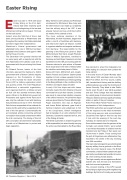
In the early hours of Easter Monday (April 24th) about 1200 volunteers took over the Main Post Of ce, the Four Courts, Liberty Hall, Jacobs biscuit factory and the distillery at Marrowbone Lane under the Command of James Connelly. They failed to take Dublin Castle even though it was lightly guarded and also Trinity College that was defended by a small group of armed unionist students. They also failed to take any signi cant railway station or parts of the port complex.
At the Post Of ce Patrick Pearse read out a proclamation of Irish Independence.
The British authorities were caught off guard and the response to the initial movements of the rising was poor and uncoordinated. Casualties were light on this  rst day and it took until the evening of the next day, Tuesday, for martial law to be imposed. Soon reinforcements from the garrison at the Curragh, just outside Dublin, were rushed in as well as thousands of soldiers from the mainland and by Friday of that week over 15,000 were in Dublin. Those coming from the port at Kingstown were attacked as they marched to the centre of the city, receiving over 200 casualties.
The main rebel strongpoints were bombarded by army artillery from a gunboat on the River Liffey but when General Lowe, the British commander, ordered infantry attacks his plan was badly coordinated and wasteful in human life, often ordering frontal attacks.
The high casualty rate enraged some British soldiers who took the law unto themselves and shot innocent bystanders.
The constant shelling of the GPO caused the building to alight along with neighbouring buildings. By this time Connelly was wounded
58 Phonebox Magazine | March 2016


