


Page 63 - Phonebox Magazine November 2007
P. 63
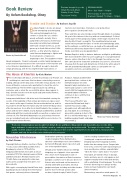
Frankie and Stankie by Barbara Trapido
Barbara Trapido's books are always teachers and classmates, their alien social and political
both entertaining and stimulating. This semi-autobiographical story centres on Dinah who as a child is weedy, asthmatic and arty. She is pampered by her anxious mother and braced by her intellectual, whirlwind father and sensible sister Lisa, as she grows up in South Africa in the 1940s and 50s – a time when the infamous
racial laws are beginning to tighten and the mechanisms of repression beginning to bite. The daughter of white
liberal immigrants, Dinah's loving and eccentric family background means that her main reaction to the overt racism of her teachers and school friends is bewilderment. It is difficult enough to deal with simply growing up, with the incomprehensible expectations of
preoccupations are beyond Dinah.
Place and time are very strongly evoked through details of everyday life, part of the texture of the story without overwhelming it. Political events pulse in the background, taking centre stage only when they directly affect Dinah's young life. The unadulterated racism and sexism which pervade the fabric of her life are breathtakingly awful, but the writing is so skilful that you can laugh at the absurdity and intellectual dishonesty dispensed to Dinah by teachers and the media, even while you are appalled by it.
Barbara Trapido's ability to balance darkness and light is spellbinding. She shows what life is like if you are caught up in social upheaval but have no option other than to try to live through it as well as you can. She cares about her characters and makes you care too; she doesn't shy away from the pain and disharmony of life but she writes about it with wit and understanding and carries you along with her – an excellent book from a wonderful writer. K
Review by Sandra Metcalf
The House at Riverton by Kate Morton
The novel begins with Grace, a former housemaid, now 98 years old As Grace, Hannah and Emmeline
and living in a care home. She has been contacted by someone making a film about the early years of the 20th century, based on the house at Riverton, someone who wanted her to check the sets for their authenticity. The first letter is ignored, but it has stirred up memories, and so when the second letter arrives, Grace agrees to help. She first visits the set in the studio and later revisits Riverton, now open to the public.
Interspersed with Grace’s life at the end of the twentieth century, the secrets of the beginning of that century are interwoven. Grace went into service at the age of fourteen, like her mother before her, and it is much later in her life that she realises why her mother left that position after she was born. Soon after she is hired Frederick, the younger son arrives with his three children, David, Hannah and Emmeline, and their relationship with the household and with one another occupies most of the book. The First World War breaks out, and several of the men join up, including David, who is killed along with his uncle. And so it is that Frederick inherits Riverton.
grow up their lives continue to be intertwined; Grace becomes Hannah’s lady’s maid when she marries and is privy to some of her secrets. But the tragedy which has remained hidden in Riverton continues to be so until the final pages of the book.
‘The House at Riverton’ was selected as Richard and Judy’s summer read, and is a light, enjoyable novel, although without any real depth. It is something to enjoy while curled up in front of the fire on a chill November day, or as bedtime reading. Read it, and judge for yourself! K
Review by Thelma Shacklady
The books reviewed above were bought from Oxfam Books and Music, Olney, which sells donated books, records, CDs, tapes and music to raise money for Oxfam’s work in combating poverty around the world. The range of books is wide, the quality excellent and prices are lower than you would pay on-line or in the supermarket. Come and visit us, find yourself a bargain, and help the world become a better place for everyone.
November Film Review
by Neil Stevens
Playwright Anthony Shaffer – brother of Peter – took London’s West End and New York’s Broadway by storm in 1970 with the intriguing chiller Sleuth; it became an Oscar- nominated 1972 film starring Laurence Olivier and Michael Caine. Revitalised anew (cert. 15) with Caine now playing the older man, Jude Law his younger rival for Caine’s non- divorced wife.
With cryptic screenplay by Harold Pinter, truly dazzling production design from Tim Harvey; lush greens, reds and yellows of beautiful
Bedfordshire perfectly captured by cinephotographer Haris Zambarloukos, directed – with telling nods to Orson Welles – by Kenneth Branagh, great crane shots and use of the repetitive frames.
Virtually a two-hander, still just as chillingly intriguing, use of gigantic close-ups make this a much more manipulative clash of personalities. Law arrives at Caine’s massive Georgian country house to discuss divorce of Caine’s wife; inside and out the mansion is decked with CCTV and endless electrical gadgets and gear, including an inside elevator built for two! It’s the last word in ultra- modern, helped along by Patrick Doyle’s
sober-sounding chamber-style score. Scathing wit competes with devilment
bringing many heart-stopping moments, battle often becoming vicious. Danger lurks from every corner. The older man being much more worldly wise, ruthless, unpredictable: “Obey the rules,” warns Caine, “my rules!”
How tables are turned I refuse to divulge, twists and turns are not only ingenious, but suggest sexuality both normal and deviant, with a splattering of bad language. The acting from two diverse types is always worthy, Caine and Law making this new Sleuth almost theatrical.
Mesmerising, marvellous mind games. K Phonebox Magazine 63
Reviews brought to you by Oxfam Books & Music Stanley Court, Olney
Tel: 01234 714592
OPENING HOURS
Mon – Sat: 10am – 4.30pm
First Sunday of each month (Farmers’ Market): 10.30am – 1.30pm
Book Review
By Oxfam Bookshop, Olney


