                                 etween winter and early spring are the best times for viewing the world-famous Northern Lights, or 'aurora borealis', and this year is no different. In fact, the best views
in decades have been predicted for this winter season, and while seeing the lights can never be guaranteed, as something which features on many people's bucket lists, it is arguably worth taking the trip. While the Northern lights can sometimes be seen from Scotland, the best place to see them is Norway. During January the days are still very short, and although they start to get longer in February and March, there are still maximum chances of viewing the Northern lights in these months. Until April, there is a 90 per cent chance of seeing the lights on a clear day. The Arctic circle in Northern Norway provides the best chance of seeing the lights, as the Northern light belt hits the Lofoten Islands and then follows the coast all the way round. The swirling, magical shapes and colours of the Northern lights are breathtaking, and there is something surreal about seeing colours and shapes in the sky which haven't been put on by a man-made light show, but rather an amazing mystery of nature. There is, of course, a highly detailed scientific explanation for how the aurora borealis come to be, involving highly charged electrons travelling from the sun at millions of miles per hour, and the electrical and magnetic reactions which take place... something which can of course be researched further by those of you particularly interested! Or maybe you would prefer to watch and enjoy the magical Northern lights without knowing the details; perhaps the mystery is all part of the fun...
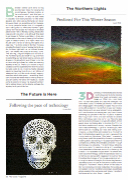
The Northern Lights
Predicted For This Winter Season Sarah WaU
   The Future is Here
Following the pace of technology Sarah \' 'all
printers, smartwatches and drones - technology seems to be moving faster than each generation can keep up. When you look back
over the last few years and see the changes that have taken place, it makes you wonder how much will change again in the coming 1 0 years. You can now print a 3D product in the comfort of your own home, take photos and use your phone from a wristwatch, and now Amazon are saying we may have drones delivering our parcels in the next 1 0 years. It seems the thing of sci-fi films, and can be hard to believe what technology can now do for us. The only way seems to be to embrace it or get left behind- which would mean not being able to function the TV or in the future maybe even accept parcels. Despite the bad press technology in general tends to get; with terms such as 'invading our lives' and 'taking over' cropping up here there and everywhere, the truth is that if all technology were to go down, we would be pretty much non-functional. This 'what if' scenario is a slight worry with the possibility of everything coming crashing down, but resting in the assumption that this is (hopefully) unlikely, the wonders provided through technology are amazing. The technology allowing keyhole surgery, for example, along with countless other healthcare advances, are simply lifesaving. As a result, it is impossible to put down the effects and positives of technology, ratherthe advances need to, somehow, be kept up with. I suppose there will come a time when the changes of technology come to a halt. . . although o n second thoughts, that is seeming less and less likely by the minute! A new announcement from Google is 'moonshot' robots, which will be used in the manufacturing and retail industries. Many jobs are being taken over by machinery nowadays, so perhaps where people in the past were coal miners, the jobs of the future will be robot fixers...how fun.
  36 Phonebox Magazine