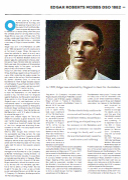
0n the passing of another Remembrance Sunday, and the approaching centenary of the start of the First World War, it seems especially appropriate to remember all those Olney men who paid the ultimate price for serving their country. Edgar Mobbs was one of those men. This article, condensed from that on the OOHS website, www.olneyhistory.org.uk , provides a summary of Edgar's heroic exploits. Mike Neale Edgar was born in Northampton on 29th June 1 882, but spent most of his early years at Dartmouth House, Olney. He began to show his aptitude for sport at a very early age. When eight and a half years old and a scholar at the Bedford Modern School, he played rugby for a school team of boys under ten years of age. He later obtained a place in his house team. A knee injury at 1 6 prevented him playing rugby for five years, but he did play hockey and cricket for Olney. It was not until 1 903, whilst still residing at Olney, that Edgar again took up the game of rugby. After restarting his rugby career, he soon came to the notice of the Northampton St James' (Saints) Club, to which he transferred in 1 905. Edgar became captain of Northampton Rugby Football Club in 1 907, a post he held for six years, and during which time he scored 1 77 tries for the club. In 1909, Edgar was selected by England to face the Australians. In this match he scored a try, the first ever for England against Australia, but the game was lost by three points to nine. Edgar gained seven England caps in all, and captained his final international match in 1 91 0 against France. England won this away match by three points to eleven. Edgar continued to play first-class rugby for Northampton, East Midlands and the Barbarians, until 1 91 3, when he decided to retire at the age of 31. Edgar also played rugby for Toulouse, where he became a great favourite. It is said that his large physique, pace, strength and tremendous 'hand-off' made him one of the most dangerous attacking three quarters of his time. He also played cricket for Buckinghamshire. Shortly after Edgar had retired from his successful sporting career, he was interviewed for 'Boys' Own' magazine on 20th September 1913. He was 32 years old and was justly referred to as 'a sporting hero'. The article confirms that he played for the Olney rugby club for one or two seasons around 1903. The outbreak of war in 1 91 4 found him as manager of the Pytchley Auto Car Company at Market Harborough, having followed his father into the motor industry. He was then contemplating emigration to Canada. When he attempted to enlist in August of that year, Edgar was initially refused a commission as, at 33, he was over the mandated age limit. Not a man to allow a trifling matter like this to get in his way, he joined up as a private soldier and raised his own unit of 264 men as ' D ' Company, 7th Battalion, Northamptonshire 48 Phonebox Magazine EDGAR ROBERTS MOBBS DSO 1882 - In 1 909, Edgar was selected by England to ce the Austra ans. Regiment. 'D' Company included many Rugby players, including E R Butcher, captain of Devon, and H Willett, captain of Bedford. Edgar arrived in France in September 1 9 1 5, and took part in the Battle of Loos. In March 1916, he was promoted to Major and in April 1916, took over command of the 7th Northants, later being promoted to Lieutenant Colonel. He was wounded by shrapnel in August 1 91 6, while taking part in an attack on Guillemont during the Battle of the Somme. After two mentions in Despatches in 1916, Edgar was awarded a DSO in December 1916 for his work as a Battalion Commander. The 7th Northants suffered severe casualties duringtheBattleofArrasinApril1917.Edgar was wounded at Messines on 7th June 1 9 1 7, but returned to the Battalion on 26th June. On29thJuly1917,whileinhisheadquarters in Canada Street tunnels near Zillebeke, Edgar, hearing of the loss of officers from the walking wounded, decided to lead the Battalion from the front. He moved to Shrewsbury Forest and was killed in action on 31 st July at Lower Star Post, while attempting to bomb a machine gun that had trapped a detachment of his Battalion. The Battalion history says: 'The fact that his body could not be recovered and buried, as all ranks would have wished, was perhaps a good thing, as it helped keep alive his memory in the Battalion and inspired in everyone the resolve to avenge his death, and to end the war that had already caused so much misery and suffering'. It is reported that of the 400 or more volunteers that served in 'Mobbs Own' Company, only 85 survived the War. On 1 0th February 1 921, the first Edgar Mobbs Memorial Match was played at Franklins Gardens, No hampton between two of the great rugby loves in his life, East Midlands and the Barbarians. This memorial match was an annual fixture at Northampton, but in 2007 was transferred to Goldington Road, Bedford. In 20 1 2, it was agreed that the match will now be played alternate years at Northampton and Bedford and for this 201 3/1 4 season it will be played at Northampton. In July 1 921, a bust of Edgar Mobbs was unveiled to his memory at the north end of Northampton's Market Square. The 'The ct that his body could not be recovered and buried, as all ranks would have wished, was perhaps a good thing, as it helped keep alive his memory in the Battalion and inspired in everyone the resolve to avenge his death, and to end the war that had already caused so much misery and su ering'