


Page 64 - Phonebox Magazine March 2012
P. 64
Charles Dickens and Bell Ringing
Charles Dickens and Bell Ringing
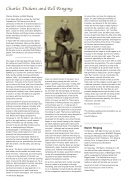
It has been difficult to escape the fact that Tuesday the 7th February was the bi- centenary of the birth of Charles Dickens so I have tried to continue the series of ‘what is the connection ?’ articles. But try hard, as I have, I could not find a connection between Charles Dickens and Olney (unless someone knows otherwise) but there is a connection with Bell Ringing.
In early 1869 he visited a practice night at Southwark Cathedral, (then just the parish church of St Mary Overie) and published an account of that visit on 27th February 1869 in All the year round, a periodical that Dickens edited. The following is an extract from that account:
*************************
The ropes of the bells pass through holes in the ceiling and reach the floor. Under each is a little raised platform for the ringers to stand on, with a strap for his foot to help him in getting good purchase, and each rope halfway up is covered for some four feet by a fluffy, woolly-looking covering, technically called a “sally”, and intended to afford a good hold to the ringer as he checks his bell in the pull down. The case of the church clock fills up one side of the room, and from it unearthly clickings and wheezings presently come as the clock strives in vain to strike. To strike a vibrating bell suddenly from a fresh quarter is to crack it, so when the bells are rung their connexion with the clock has to be temporarily severed.
Coats are taken off, sleeves are turned up, and business is evidently about to begin. But nothing connected, however remotely, with music can be done without a quantity of tuning or other preliminary performances, and change-ringing is no exception to this rule. Before the ringing can begin it is necessary to “set” the bells: to set a bell is to get it on the right balance, mouth upward. Some of the bells are set already, some consent to be set with little trouble; but the tenor, a small plaything of fifty-two hundredweight, or thereabouts, is obstinate tonight. Three youths take him in hand, and presently his deep note booms out sonorously, but he absolutely declines to assume the required position. We take the opportunity to go up, preceded by our friend, with the lantern, into the belfry, and among the bells.
As we go , the tenor’s voice becomes louder and louder, and the ladder and walls shake more and more, until at last, as we are going to step on to the platform of the bells, we shrink back as from a blow, from the stunning clash of sound with which he greets us. He is rather an alarming object to behold, swinging violently to and fro close to us, and we decline the invitation to step past him on to the staging beyond, for which feat there seems to us but scant space. Our conductor
does not disturb himself in the least, but is presently busy among the bells, with his lantern, tightening a rope here, looking after a wheel there, sublimely indifferent to the clanging monster so close to him. And now, as we watch the bell swinging, we become, painfully sensible that two of our favourite bell stories must be abandoned, if this be the customary method of ringing church bells; which on inquiry, we find it is. There was a melodrama of thrilling interest once played – at the Victoria was it? – in the last act of which the hero was to be shot, or executed in some way, and the signal was to be given by the tolling of a bell. The heroine, bethinking herself that, if the execution were delayed for some time, her lover would be saved, ascended into the belfry, and, when the bell began to ring, herself swung by the clapper; by which ingenious gymnastic manoeuvre she rendered the bell dumb. This might be all very well – although we had secret doubts about it – with a bell hanging mouth downwards and swinging only from side to side, but how about a bell the other way up, describing a circle, and sounding only when it again assumes an upright position, and the clapper falls? The story, albeit said to be founded on fact, must be given up, we fear. Quasimodo, again, however abnormal his activity, and, however remarkable his familiarity with his bells, would find it difficult to ride this uncomfortable-looking tenor – Quasimodo would be dashed to pieces against the platform presently.
All at once, alarming tenor comes up slowly, hovers, poises for a moment as though hesitating, and sets his great mouth, five feet or so in diameter, turned at last the right way. All his companions have been in this position
for some time, and now the ringing can begin. So, after feeling the thickness of tenor’s sides and sounding him with our knuckles, we descend to the floor below, where we find the ringers ready. A glance round from the conductor, who, with two assistants, rings the tenor, “go”, and they start. The tower rocks, the bells clash, tenor booms at appointed intervals. After some little time, one gets used to the noise, which is not so great as might be expected, and begins to pick out the rhythm of the chime. The ringers all have an earnest fixed expression; attention is written on every face. Occasionally a slight wandering look betokens that the ringer is a little vague as to his place in the change, but he soon seems to pick it up and come right again. The work is severe, especially on the arms and muscles of the back, but is done with an ease derived from long practice. The rope is pulled down at the sally, and falls in a loop to the floor; as it begins to fly up the ringer checks it, the bell is balanced against a wooden stay that prevents its falling over, and the clapper falls; then he lets it run up, round goes the wheel above, and with it the bell, and presently the bell’s mouth comes up on the other side, and the clapper sounds again. It is a delicate operation, checking the bell on the poise; if done too late, the bell breaks away the restraining stay, the rope flies up, and probably disappears through the hole in the ceiling, drawn up round the revolving wheel, and disgrace is the portion of that youth. Disgrace and pecuniary penalty, for a fine is inflicted for a broken stay.
By Charles Dickens *************************
The wording, spelling and punctuation are as per the original article
David Phillipson
March Ringing
On Monday, 12th March from noon for about one hour, a visiting group “ROOMS” (Ringing Outings On Mondays) will be ringing under the guidance of Don Salisbury. Don expects to bring 14 to 16 ringers from a variety of towers centred around Stotfold in Bedfordshire.
On Saturday, 17th March, Starting at 10.00 am there will be a peal attempt by the Bedfordshire Association of Bellringers which will be conducted by Anthony Smith from Biggleswade. The method to be rung is called “Bedfordshire Delight Royal” which is a method in which all ten bells are involved.
Good luck to both of these groups and we hope you enjoy your visits to Olney.
Helen Dilley
64 Phonebox Magazine


