


Page 67 - Phonebox Magazine March 2011
P. 67
Bellringing in Olney Parish Church
Lea the stro
Last month I wrote about how bells are “rung up” until they are in an upside down position. Not only that, the English way of ringing bells is by turning the bell through a full circle, from the mouth up position, by pulling on a rope attached to the bell wheel. Each rotation causes the clapper to hit the bell once. At one pull the rope is wound onto the wheel making the ringers stretch up. The next rotation the rope is pulled back down again. In this way the bell goes back and forth in a way that can be controlled by the ringer so that he/she can get the bell to sound at just the right moment, according to the pattern being rung.
You may be thinking that this is all a lot to do if you have never rung a bell before – and you would be quite right. Ringing is something of a skill or a “knack” which has been likened to riding a bicycle and, I am told, once learnt it is never forgotten but, because it is unlike anything else, it does have to be learnt. Luckily for us the skills required can be taught by breaking them down into small steps and learning them one at a time before stringing them all together.
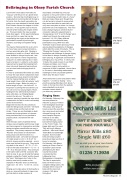
In order to understand this better you need to know the rope which is attached to each bell assembly comes down from the belfry into the ringing chamber and, at about head height it has a fluffy bit called a “sally” to assist the ringer. Below the sally is a further length of rope – the “tail-end”. In the picture “Learning the hand stroke” you can see one of our young ringers, Rosie, holding the red, white and blue striped sally, while Alan, our Ringing Master controls the tail end. The skill is, in essence, learning to handle the rope which is attached to the bell in order to accurately control its movement.
Beginners first learn the two strokes to make the bell go back and forth – the hand (or sally) stroke and the back (or tail) stroke. These two are illustrated as best I am able by the two pictures of a learner being instructed but it is not possible to properly show a movement with still images.
After the basic skill is mastered the two strokes are put together and the new ringer can then progress to ringing alone and later taking part when several bells are rung in sequence. The primary sequence is called “Rounds” and consists of several bells being struck one after the other in a (downward) scale. Let’s take an example of 6 bells tuned to A, B, C, D, E & F for which 6 ringers would be required – one to each rope and bell to be rung. They would ring them in the order F – E – D – C – B – A all on the hand stroke then F – E – D – C – B – A on the back stroke. This continues in the same order until the conductor tells them to stop. In any set of bells the highest pitched is called the “treble” and the lowest the “tenor”. Bellringers don’t refer to the bells by note but by number so the example of “Rounds” above is written by ringers as 1 2 3 4 5 6, 1 2 3 4 5 6 , and so on.
Ringing just rounds gets a bit boring after a while so, when all the band of ringers can get their bells to strike rounds in a
reasonably controlled way, they can
progress to mix up the order to make it a bit
more interesting and with more of a “tune”.
Bells are heavy things and, though they
can be hurried or slowed to some extent,
they cannot be bullied so each bell can
only move one place at a time i.e. change
place with one of its neighbours. The most
basic change ringing is achieved by the
conductor calling for adjacent bells to
change places. So if “2 and 3 change” were
called from Rounds the order would
become 1 3 2 4 5 6. Many different
changes can be called and many hand permutations rung. With more skill,
“methods” may be learnt and rung. These
are pre-determined patterns of changes
which affect the order of the bells. This is
“Ringing the Changes” and part of the
fascination and challenge of change ringing
is that there is always something new to
learn and ring. A significant achievement in
bellringing is to ring a Peal. In Olney, with
10 bells, this would consist of over 5000
changes and takes over 3 hours
continuous ringing, during which no
sequence of bells is repeated. Hence there
is, for some, a fascinating mathematical
challenge to work out possible patterns
which obey the above “rules”.
All are welcome to come and observe what happens – or even try ringing – at our practice evening (Mondays from about 7 – 9 pm) or find out more from the website www.olneybells.co.uk which
includes contact details if you have any questions.
Ringing News
On Saturday, February 12th we were pleased to welcome a group of visitors from Nottingham University. This group, who rang at 5 towers around the area that day, rang rounds and called changes through to the more complex Surprise methods on ten bells.
On 19th February a local band will be ringing a peal on the “front 6” bells - the bigger bells won’t be used. They will ring 3 different methods – Kent and Oxford Treble Bob and Cambridge Surprise. As the smaller bells are being rung the peal should take less than 3 hours to complete.
On Saturday, 19th March starting at 10am a Peal of Grandsire Caters will be attempted by the Kent County Association conducted by Roy LeMarechal from Bishopstoke in Hampshire. The Peal is expected to take over three hours to complete. Being Caters, the changes will be rung on 9 bells with the tenor bell ringing in 10th place throughout.
Learning the tail stroke
rning ke
Orchard Wills Ltd Member of the Society of Will Writers
ISN’T IT ABOUT TIME YOU MADE YOUR WILL?
Mirror Wills £80
Single Will £60
Let us visit you in your own home and take your instructions
01234 713938
Wills prepared within seven days
Phonebox Magazine 67


