


Page 45 - Phonebox Magazine January 2011
P. 45
“little Daughter”
I never seem to find the time to do a great deal of reading these days, possibly because I spend far too much of my leisure time staring at a computer monitor. However, I continue to
Zoya’s father had continued his work as an activist with the Karen National Union and had become a target for the Burmese regime. His life was under
constant threat, but he was de- termined to carry on. Zoya had also come to the notice of the regime and found her life was also at risk, so in 2004 she fled to the UK on false papers and claimed asylum. Her older sister Bwa Bwa had previously es- caped to the UK and was able to advise her of the necessary processes to follow. Those were
worrying days as, at any time, Zoya could have been deported to Burma and almost certain death. Despite her status, Zoya was able to enrol as a student at the University of East Anglia to pursue an MA in Politics and Development. It was during this time that Zoya began to discover the truth about the scale of human rights abuse and torture in her homeland, as all news output in Burma is controlled by the regime.
In 2005 Zoya’s sister, Bwa Bwa, invited her to take part in a ‘free Burma’ march in London to celebrate the birthday of Aung San Suu Kyi, the leader of the National League for Democracy. I was interested to read Zoya’s comments about the role of the police in this march:-
“As we walked, a couple of policemen placed them- selves at the front and rear of the column of marchers. At first
I watched what they were doing a little nervously, but their main concern seemed to be to stop the traffic at various points so we could march safely onwards. They certainly did nothing to stop us. It was amazing. No one was arrested. No one was carted away.”
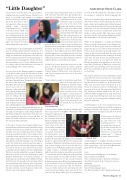
Zoya and Bwa Bwa
Zoya was asked to speak at the march, which brought her to the attention of the BBC’s “Newsnight”. Her subsequent appearance on
the programme led to an of-
fer to become involved with
Burma Campaign UK. With
Aung San Suu Kyi still under
house arrest at this time, it
was probably inevitable that
this remarkably eloquent
young lady would become
the representative voice of
her people. Zoya still faced
problems however. Her UN refugee status in Thailand was due to expire in July 2005, but she could not risk returning to Thailand as the Burmese security services were actively looking for her. It was thus that Zoya decided to go to the Refugee Legal Centre in London to lodge a claim as a political refugee in the UK. Sadly Zoya’s first attempt to attend the centre on July 7th was thwarted when London was totally paralysed by terrorist attacks on the public transport system. Her second attempt on 21st July was also thwarted by further terrorist scares. When Zoya finally managed to get an interview she was advised that she could face twenty years in prison for what she had done. Zoya was finally released after promising that she would visit her local police station every week. Two years later the Home Office gave Zoya permission
A review by Steve ClArk
to work in the UK and she was then able to devote her energies to working for Burma Campaign UK.
The issue of a British refugee travel document meant that Zoya was able to travel and, despite the risk she faced, a trip to her homeland and her father beckoned. This was to be the last time that Zoya saw her beloved father alive as he was assassinated in February 2008 shortly after her return to London. She had lost her mother to illness in July 2004. Once again, despite the risk to her life, Zoya and her siblings returned to their homeland for the funeral of their father.
Whilst “Little Daughter”, co-written with Damien Lewis, necessarily concentrates on the desperate sit- uation of the Karen people and the constant chal- lenges they face it is not without many moments of humour. Zoya’s attempts at mastering modern tech- nology in the civilised world after her years in the jungle certainly presented some challenges! In recent years Zoya has really become an international icon with many contacts at very high level within the British government. Her appearance at the Conser- vative Party Conference in 2006 led to a return invi- tation in 2007 and a standing ovation from the dele- gates. You can find Zoya’s speeches to the conference on ‘You Tube’.
The situation in Burma receives considerable coverage in the UK. The recent sham ‘elections’ on November 7th 2010, just before the release of Aung San Suu Kyi kept the matter in the public eye. In November 2010 there were 15 written and 8 oral questions in the House of Commons, as well as 3 written and 11 oral questions in the Lords. There have also been 6 Early Day Motions on Burma tabled so far this year. A number of MPs of all parties have made it their busi- ness to keep the profile high, but much more needs to be done by the international community and by the UN in particular.
“Little Daughter” is the most inspirational book I have ever read and I believe it should be compulsory reading for anybody who aspires to government in this country. Zoya comments at the end of the book:
“I don’t want you to feel sorry for me, I want you to feel an- gry, and I want you to do something about it.” ... “So few people know what is go- ing on in my country, but you do now. Will you do some- thing about it, or just pick up another book?” ... “I want to go home. Please help me.”
Downing Street
“Little Daughter” is available from all good book- shops including Amazon. Alternatively you can pur- chase a signed copy of the book from Burma Cam- paign UK for the modest sum of £7.99.
Links:
Email: stephen.clark89@yahoo.co.uk Website: http://tinyurl.com/km9hdd
Steve on Facebook: http://facebook.com/tiliacus Zoya Phan Facebook: http://facebook.com/zoy- aphanpage
Burma Campaign UK: http://burmacampaign.org.uk
The Phan Foundation: http://phanfoundation.org
buy books from time to time in the hope that I will get around to reading them eventually. Consequently I have a number of books at home which await my attention. Just for once, there was something about my most recent purchase which urged me to read it and, having started to digest the contents, I found it almost impossible to put down.
Zoya Phan
“Little Daughter” is the autobiography of Zoya Phan, now 30, an ethnic Karen refugee from Burma. As a teenager Zoya had to flee from her country after her village was attacked by the Burmese army. She now lives in London and works for the human rights or- ganisation Burma Campaign UK. The book follows the extraordinary story of Zoya’s childhood, her life as a refugee and her final transition to become an iconic campaigner for a nation enslaved.
Zoya was born in the Burmese jungle as a member of the Karen ethnic group. For decades the Karen people have been under attack from the Burmese military junta. Zoya’s parents were both active within the Karen National Union. The family lived in a bam- boo hut on stilts close to the
Moei River. The early part of
Zoya’s book tells of the
pleasures of her early child-
hood, playing simple games
and hunting for edible fungi
with her siblings. We also
learn how, at the age of two,
Zoya almost died. She had
been rendered unconscious
after suffering high fever, but
the only nurse in the village clinic had given her up for dead. Zoya’s mother set off on a long trek through the jungle to seek help in a nearby village, despite be- ing heavily pregnant. Fortunately the nurse there was more sympathetic and Zoya was nursed back to health. As readers will discover, this was not to be her only near-death experience.
At the age of fourteen Zoya’s happy childhood was devastated after the Burmese army attacked her village and left it in flames. Zoya’s family were forced to flee and spent two years running away from the military action along with thousands of other refugees. Zoya eventually found sanctuary across the border in a Thai refugee camp, but conditions were very difficult, although she eventually managed to get UN refugee status. The family were scattered and no longer to- gether and Zoya’s mother was becoming increasingly ill and weak. However, Zoya had always been keen on getting a decent education and was a gifted pupil. This fact eventually enabled her to escape to Bangkok, where she was able to take up a scholarship to study Business Administration at St Theresa Institute of Technology, an international school affiliated to Brad- ford University. Zoya’s studies led to her being offered a work placement with Telecom Asia Corporation. She was eventually offered a job with the corporation, but Zoya wanted to use her education to help to fur- ther the cause of her people in Burma.
Phonebox Magazine 45


