


Page 67 - Phonebox Magazine May 2009
P. 67
Juniper Hill to Buckingham?
Steve Clark explores the background to a literary and television favourite
Flora Jane Timms was born on 5th December 1876 in the hamlet of Juniper Hill, close to the Oxfordshire/
Buckinghamshire border. Her father Albert, a stonemason from nearby Buckingham, married Emma Dibber from Ardley, Oxfordshire. Flora was the eldest of six children and went to work in the Post Office in Fringford at the age of 15 as assistant to the Post Mistress. This scenario may sound rather familiar as Flora eventually recounted the experiences of her early life in a series of semi-autobiographical books, and these were to become the basis for a serialised period drama from the BBC.
The programme became a very firm Sunday night favourite, consistently attracting audience figures in the region of 6 to 7 million.
In 1910 Flora Thompson acquired a typewriter to enable her to type the minutes of her husband’s Post Office meetings. She also used the machine to type some of her earliest literary work and in 1911 she won a competition in “The Ladies Companion” for an essay on Jane Austen. This was her first published work. Sadly, there is evidence to suggest that John Thompson was not an enthusiastic advocate of Flora’s literary skills. It is perhaps not surprising that Flora’s three semi-autobiographical books about her early life did not actually see the light of day until she was in her sixties. “Lark Rise” was published by Oxford University Press in March 1939, “Over to Candleford” followed in February 1941 and the series concluded with “Candleford Green” in January 1943.
4th January to 15th March 2009. Writing for the third series is under way, with the programmes expected to be aired in 2010. Although Flora Thompson’s original works were set in the area around Buckingham, actual filming takes place in the parishes of Neston and Box in north Wiltshire.
The central casting of Olivia Hallinan as ‘Laura’ could have been seen as an ambitious move, as Olivia had previously been best known for her role as Kim Lewis in the critically acclaimed TV adaption of Julie Burchill’s “Sugar Rush”. The choice of Brendan Coyle and Claudie Blakley to play Robert and Emma Timmins was perfect. Indeed, the whole cast shines throughout all of the programmes, including Dawn French as the unfortunate Caroline Arless. New
characters have been introduced at various points throughout the series, and it was good to see the introduction of Rebecca Night as Nan Carter towards the end of the second series. Rebecca had previously been the central character in the most recent TV adaption of “Fanny Hill” and so, like Olivia, had probably gained a degree of notoriety!
I am absolutely thrilled that so many people have become enthusiastic viewers of the Lark Rise to Candleford series. Moreover the success of a period drama like this often has
a spin-off; in that many viewers then go on to read the original novels. I can only hope that this will indeed be the case and that
many people will go on to discover more about Flora Thompson and her novels. The “Lark Rise to Candleford” trilogy is available from all good bookshops, online from Amazon, or from The Old Gaol Museum in Buckingham, where there is a permanent Flora Thompson exhibition. The first two series of the BBC adaption of the programme are available on DVD, the second series having been released on 20th April. Needless to say, “Lark Rise to Candleford” also has its own group on Facebook!
Further information:
Flora Thompson website: www.johnowensmith.co.uk/flora/
Lark Rise to Candleford website: www.bbc.co.uk/larkrise/
Flora Thompson exhibition: www.mkheritage.co.uk/OGB/flora.html
To contact Steve: stephen.clark89@yahoo.co.uk or steve@mklibdems.co.uk
In the transition from reality
to literature the hamlet of
Juniper Hill became Lark
Rise and the market town of
Buckingham became
Candleford. There was a
more subtle change to the
names of the characters in
the books, as Albert, Emma
and Flora Timms became
Robert, Emma and Laura
Timmins. In the first book
“Lark Rise”, the birth of a
new baby brings financial
hardship to the Timmins
household, obliging eldest
daughter Laura to leave her home in the quiet hamlet of Lark Rise to embark on a new life in the busy neighbouring town of Candleford. The real Flora worked at the Post Office in Fringford, just to the north east of Bicester, from 1891 until 1897. She worked at a number of different Post Offices during her life, but it was her appointment as Assistant Postmistress in Grayshott, Hampshire in September 1898 which was to provide her literary inspiration. Several of the eminent writers of the day, including Arthur Conan Doyle and George Bernard Shaw, were regular customers at Grayshott. Flora left Grayshott in 1901 and after a short time at Yately she ended up in Twickenham in 1902. It was in Twickenham that Flora Timms married another Post Office employee, John William Thompson, on 7th January 1903. Shortly afterwards, the couple moved to Winton, a new suburb of Bournemouth. The opening of the public library in Winton in 1907, allowing Flora to benefit from good access to books, was another major influence in her life.
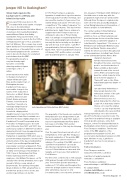
Julia Sawalha and Olivia Hallinan (BBC photo)
The popularity of the three books resulted in their publication as a trilogy entitled “Lark Rise to Candleford” in April 1945. Sadly, it was not long afterwards that Flora died in her sleep on 21st May 1947 and her husband followed on 13th July the following year.
Over the years there have been all sorts of interpretations of the Lark Rise trilogy, but the lavish serialisation of the work by BBC Drama brought it a whole new host of admirers. The casting of the BBC version of “Lark Rise to Candleford” can only be described as inspirational, particularly the choice of Olivia Hallinan as Laura and Julia Sawalha as Dorcas Lane, the Candleford Post Mistress.
The first series commenced on 13th January 2008 and ran through until 23rd March that year. The very first episode attracted an audience of 7.27 million and throughout the series the average audience was 6.4 million. After a Christmas ‘special’ on 21st December 2008, a second series aired from
Phonebox Magazine 67


