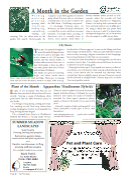
A Month in the Garden Weeding, watering, pruning, spraying, dead heading, barbequing, sunbathing, relaxing and This pest has spread throughout most of mainland England now, but was once quite a rare sight. But as the climate in the UK becomes warmer, and the winters milder, it has been able to survive from year to year. Fortunately, it does not a ect any other plants than lilies (]ilium) and fritillaries (fritillaria). Hampton Court Show garden will not be going ahead this year, due to unforeseen circumstances, but we aim to build it for the 2005 show - I shall keep you posted! develop diseases unless pruned in mid summer, when the wounds will heal quickly. Larger branches on Magnolias, Prunus, (including both ornamental and fruittrees)andwalnutscanbesafelysawn off, using a sharp saw and prune back closetothemaintrunk.Ifindoubtwhen dealing with large trees, call in the services of a tree surgeon to safely prune them. enjoying. That just about sums up the garden this month! Unfortunately, the To encourage flowering spurs on Wisterias, cut back all wispy side-shoots towithinfiveorsixbudsformthemain branches. Although heavy pruning of deciduous trees is normally done m winter, some species bleed badly or Linette Applegate bright red, shiny beetles about 8mm long, with black heads and legs. These start to emerge from the soil when the days a warmer in April. After mating, Lily Beetle batches ofsmall brown eggs can be seen on the foliage, and from these emerge lily beetle larvae. These are quite di icult to spot at times, as they cunningly disguise themselves as bird droppings, by covering themselves with their own excrement. The adults are quite eye-catching, Keep vigilant from April, ifyou squash any beetles you find on your plants, you will prevent them mating and producing any larvae, which should also be removed and destroyed when spotted, but this is a slightly messier process! Chemical control can be achieved by using Provado Ultimate bug killer, available from many garden centres. It is the rate these larvae feed on the foliage that can decimate an entire plant in days. The adults also eat the leaves but are not so destructive as the young grubs. Plant of the Month - Agapanthus 'Headbourne Hybrids' n spite of the reputation that they are not Ihardy, these wonderful African lilies will thrive outside. Forming a clump of deciduous, shiny green leaves they can add a structural quality to any border. These are held in umbels ofaround 50 trumpet shaped individual flowers. Followed by equally attractive seed heads, the season of interest is extended for these superb specimen plants, equally at home in the border or in a pot on the patio. The foliage is long lasting, arching and strap like, reaching around 70cm long. Above these emerge the gorgeous flowers, on strong stalks l m long, during July and August. Generally reaches a height and spread of l m x 70cm, and prefer a sunny spot in fertile, well The cultivated form known as Headbourne Hybrids has flowers in varying shades of blue. drained soil. garden plans available Pet and Plant Care SUMMER MEADOW www. applegategardens. com - instant online om £9.99 LANDSCAPES Good Quality Fencing, decking and pergolas Restoration, garden design, construction and planting service also Garden maintenance, tur ng, pruning and tree surgery For a reliablefriendly service contact: Tel: 01604 862293 Mark Smith obilif(;;:, 2 PAGE 50 THE PHONEBOX