


Page 41 - Phonebox Magazine October 2016
P. 41
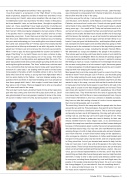
my voice. We all laughed and smiled, it was a good day.
I was then taken to a restaurant on the “High Street” in the camp, made of plywood, tarpaulins and bits of metal here and there. It was late evening and I hadn’t eaten since breakfast. We sat down in this incredible place and I was stunned by the décor inside, nothing fancy but it was beautiful. Later, as I sat there alone, I thought to myself how lucky I am. I have everything I’ll ever need around me; my family and friends, a roof over my head and food on the table. Then I remembered that I had a £1,000 pound guitar strapped to my back, plenty of Euros in my pocket, was in a strange place with no police and lots of very desperate young men. If ever there was a time that I was vulnerable then this was it. Mainstream media has an insidious way of sneaking into your mind and scaring you. I was mulling this over when a friendly face came over and said “tea sir?” He had a pot of hot creamy tea that he poured into a little cup and handed to me with a big smile. He then asked me if I’d like to eat, let me tell you this; the food was wonderful. When I went to pay, the boss approached the counter and asked if I played “that thing” on my back? Never one to miss a chance to play, I had my guitar out and was playing one of my songs. The whole restaurant loved it and big smiles and applause  lled the room. The place was packed inside and out with people queueing at the door and watching through the windows. The “boss” walked over, sat down next to me, and told me that my food was free for today and it would be free tomorrow if I came back. I sat chatting with him and he invited some more people to the table, all with incredible stories to tell: a man from Syria who’d lost all his money, a young man from Afghanistan who’d lost his whole family to the Taliban. I sat and listened asking a few questions here and there; it was heart-breaking and I was amazed at how these people didn’t hate, I think maybe I would have hated, but they were so full of hope. The boss begged me to write a song about all I’d seen and heard in the camp.
The next day I had to meet a drummer friend of mine at the Calais ferry port who was coming over from the UK to play drums with us. Geoff was gobsmacked at how many people I seemed to know in the camp. Of course in reality I knew very few, but word passes very quickly in a
tight community full of good people, starved of music. Later that day I was introduced to some people from Channel 4 television, they were there to  lm what life is like in the camp.
Day three was just fun all day, I met up with lots of musicians from all over the place, some Syrians, some Afghans, some Iraqis, some from Pakistan, and some from London who I found out were good friends with a friend of mine called Dick Philpot. He and I used to play in a band many years ago – it’s a small world. Today we had some work to do, we had all met up in a restaurant that had a wonderful back yard that looked out onto a lake, the idea was to record and  lm one of my songs with the lake as the backdrop, so we all sat inside the restaurant and rehearsed my song over and over again until we all had it  rmly in our hearts. It was just good old-fashioned fun, and the place  lled up with lots of people who were eager to see and hear what was going on. After  lming we sat in the restaurant for the rest of the day drinking tea and taking turns playing our songs, including the fantastic Hannah White. We alternated our songs and chatted to the people in the audience. Their stories went on all day, until it was time for some of us to catch the ferry back home to old Blightie. When my friends left and had all gone I once again walked around the camp on my own, I wanted to soak up the feeling as much as I could, I walked over to the bridge entrance as the sun was coming down on a hot summer’s night, there were games of cricket and games of football happening all around me and I couldn’t help but think how amazing the human spirit is.
Most people that I met in the camp didn’t want to come to the UK, they wanted to learn French and get a job in France. Lots would be going out of the camp looking for work every single day. Another thing that I learnt was that some of those in the camp wanted to stay there, yes they wanted to stay in the camp, one man told me that it was the  rst time in many years that he had found peace; he said that he felt safe in the camp, and of course no-one was dropping bombs on his head. There were many who wanted to come to the UK, especially as lots of them have family here. They think that we’re the land of opportunity; they have never been told that there is mass unemployment here, they’ve never heard of Workfare or zero hour contracts or disability cut backs, they have no idea that renting a house in London is more expensive than most working people earn in a month.
The main thing I found in the camp was that the people who live there are just like you and me. They want peace, they want to work, they want to fall in love and have a family and a home. This is 2016 and camps and poverty and war are all still happening. One day we’ll get round to sorting it all out, and that day can’t come quick enough for me. They are the victims of those in power who want to destroy for their own means; whether that’s for land, religion wars, or oil, and these poor people in the camp have seen their countries and their homes destroyed because of other people’s greed. Luckily, there are many good people who feel that need to help. Our very own John van Weenen has done amazing things in his life to help other people who are less fortunate, and I know that he’s a much richer human being for the experience. John arranged a collection of donations of clothes and blankets and transport to the jungle camp only last winter, and lots of good people in Olney joined him. Lots of you donated and wanted to help, but the help can’t just stop, it can’t stop until all the people in the camp have found a home. There is much more that can be done; we can write and email our Government and demand that we help as a nation. Use your voice, put our elected representatives to the test, and if they do the decent thing and help other human beings who need our help then stick with them. It really is time to take control and demand a better future for everyone, including those displaced by cruel and illegal wars, the people on the jungle camp deserve that at least. It’s up to us to make the change happen. If you care about it, then do something about it. Go to www.ianrobertsmusic.org for more information on Ian, his music and to read the full article.
October 2016 | Phonebox Magazine 41


