


Page 41 - Phonebox Magazine April 2016
P. 41
Olney Camera Club Shutter Speed and Moving Subjects
Shutter speed is responsible for creating dramatic effects by either freezing action or blurring motion.
The shutter speed setting [S] on your camera is measured in either Seconds, 10ths, 100ths or 1000ths and determines the
length of time when the digital sensor inside your camera is exposed to light, that is the length of time the camera’s shutter is open when taking a photograph.
The camera’s shutter speed, the lens’s aperture (also called f-stop – focal ratio), and the scene’s luminance together determine the amount of light that reaches the image sensor and is proportional to the exposure time.
As the length of exposure increases if anything is moving – you or the subject, there will be a motion blur.
Short exposure times are sometimes called “fast” and long exposure times are called “slow”.
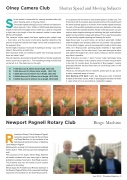
The set of pictures shown demonstrate the effects of shutter speed and motion, and how you get from: 1. The everything moving shot (blurred) on the left, to 5. The static shot on the right.
In our pictures we move from a slow shutter speed to a faster one. The  rst picture with the slowest speed shows blurring of the windmill and the water droplets appear as a stream. As the shutter speed increases the sails of the windmill gradually become more de ned and the water resolves itself into separate droplets. Finally in the last picture, you can see tiny water droplets catching and re ecting the light, and the  ower pattern on the windmill is sharp and de ned. This is a perfect example of a fast shutter speed capturing and freezing the action.
Apply these rules to a sport scene, car racing in good light, football under  oodlights and amazing detail can be possible. Say goodbye to those blurry images, you are now equipped to capture fast moving items, be it  owing water, spinning plastic windmills or high speed motor sport action. On the other hand, if you want that special effect and capture the judge’s eye, slow it down, hold your camera still and any effect is possible.
Note. Everyone can learn, I learnt “snowy” water techniques (long exposure) from friends at the camera club and I have only just learnt in the last 12 months about the bene ts of ‘Big stoppers’- heavily graduated Neutral density  lters that can slow things down in the brightest of lights.
Thank you for taking the time to read this, please give it a go, but on a better composed image of course.
Next Meeting: 27th April: Salon des Refusées (John Credland) 8.00pm at the Olney Centre. A talk on photographs that failed to make it. Learn what not to do (according to competition judges).
1) 1/10th Second, f8, 50mm focal length. (ISO 100)
2) 1/25th Second, f4.5 50mm focal length. (ISO 100) 3) 1/250th Second, f2.8 50mm focal length. (ISO 360) 4) 1/2000th Second, f2.8 50mm focal length. (ISO 3200) 5) 1/4000th Second, f2.8 50mm focal length. (ISO 6400)
12345
Newport Pagnell Rotary Club
Recently the Rotary Club of Newport Pagnell, received a request to help with the purchase of a Bingo Machine, for the residents of the Abbotswood retirement homes, in Westbury
Lane Newport Pagnell.
Abbotswood is a group of 22 retirement and sheltered homes built in 1985, and has part time management staff.
The purchase of the Super Select Bingo Machine will enable residents who may have sight or hearing problems to partake more fully in their Bingo sessions. This machine also has the facility to pick random numbers for the lottery.
Wendy Egan the President and Richard Coleman of the Newport Pagnell Rotary Club, presented the Bingo machine to the residents on the 2nd February 2016.
Bingo Machine
April 2016 | Phonebox Magazine 41


