


Page 12 - Phonebox Magazine November 2014
P. 12
Milton Keynes’
Stonehenge
by James Willis, author of ‘Mysterious Milton Keynes’
Neolithic monuments, mounds and standing stones have littered the British Isles for thousands of years. Speculation as to their original purpose abounds, with
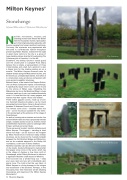
theories ranging from human sacrifice to astrology. Curiously, the mysteries are perpetuated and honoured in, contemporary fashion throughout present day Milton Keynes. Indeed the first sight to greet many visitors to the city is a group of huge standing stones atop the hill overlooking The Coachway just off Junction 14 of the M1. Elsewhere, the striking ‘Gnomon’ stands guard over the cricket pitch in Campbell Park. Many believe this is simply a representation of three cricket stumps and a ball, but a gnomon is also a Greek term for the shadow-casting pin on a sundial. The Milton Keynes Gnomon casts its shadow directly along the Midsummer ley line, and the enormous, untreated slate stones, from which it is constructed, evoke an obvious comparison with more ancient megalithic structures.
Behind Yates’s, in the heart of the Theatre District, one can find a scaled down replica of Stonehenge. A significantly larger stone circle can be found on the shores of Willen Lake. Straddling the Midsummer ley line is the Medicine Wheel, a huge structure made up of over one hundred limestone rocks. It is here that the city’s many pagans and witches hold their regular ‘moots’ and ‘esbats’. Three further gigantic circles, made up of over one hundred limestone boulders, can be found alongside the Grand Union Canal in Great Linford, between St Andrews Church and Church Lees. The newest stone circle – installed earlier this year - can be found just outside the ‘city limits’, in the pocket park at the entrance of the village of Deanshanger.
As well as creating stone clusters and circles, the ancient British tribes also had a propensity towards simple, isolated stones known as menhirs which are believed to have been used for (amongst other things) spiritual and social rituals.
There are several ‘modern’ menhirs dotted around Milton Keynes. The biggest – standing at least eleven foot high - can be found on the footpath by White Horse Drive in Emerson Valley. Similar structures can be found on the riverside footpath between the Old Stratford Bridge and Wolverton, and on the roadside adjacent to the Galley Hill roundabout, south east of Stony Stratford. Neolithic inspiration can also be seen in the names of city streets. Avebury Boulevard is named after the largest stone circle in the world, which lies in the village of Avebury a few miles north of Stonehenge, whilst Silbury Boulevard is tribute to a significant Neolithic chalk mound in Wiltshire. This has been but a whistle-stop tour – keep your eyes open and you will undoubtedly spot plenty more. The truth is that the very fabric of Milton Keynes is a living homage to the intrigue and esotericism of the ancients. Perhaps, in five thousand years’ time historians will be debating the purpose and meaning of the ‘Milton Keynes Monuments!’
12 Phonebox Magazine
The Gnomon
Emerson Valley ‘Menhir’
Milton Keynes Stonehenge
Embedded into a wall in Emberton Park
Medicine Wheel by Willen Lake


